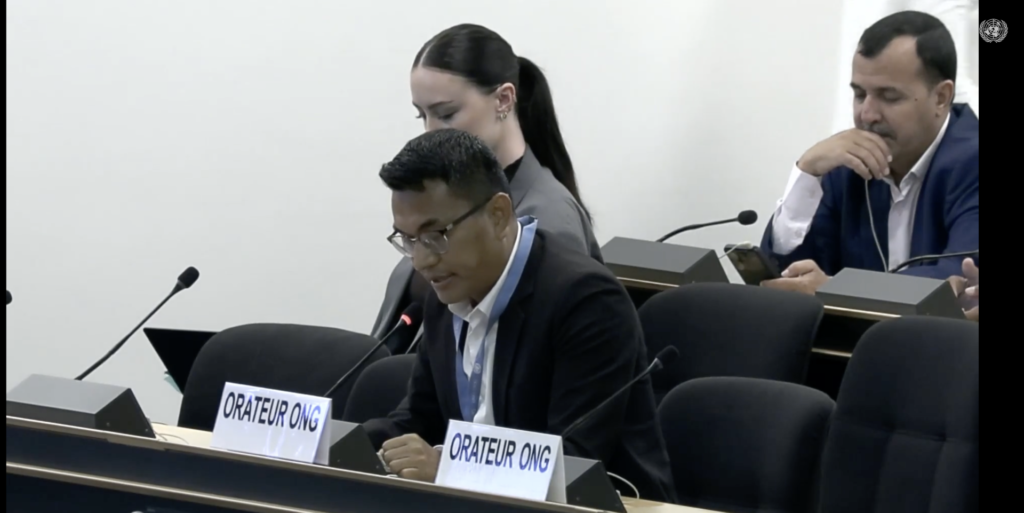
UN Advocacy Officer Phuntsok Topgyal from the Office of Tibet in Geneva delivered an oral statement during the 63rd Session of the United Nations Human Rights Council (UNHRC) under General Debate, Item 3, on behalf of the Society for Threatened Peoples.
Addressing the Vice-President of the Council, the CTA’s UN Advocacy Officer expressed serious concern over policies that, according to Tibetan representatives and human rights organisations, threaten Tibetans’ cultural rights, freedom of religion or belief, and ability to preserve and transmit their language and cultural identity.
He highlighted the case of Lobga Rangzen, who died after self-immolating outside United Nations Headquarters in New York on 2 July 2026, one day after China’s new “Law on Promoting Ethnic Unity and Progress” entered into force. International Tibet Network reports that Lobga Rangzen’s act took place outside the UN Headquarters on 2 July, while Amnesty International has also called for renewed international scrutiny of the circumstances surrounding his death and the broader human rights situation in Tibet.
UN Advocacy Officer Phuntsok Topgyal stated that Rangzen had chosen the United Nations because he believed the institution stood for justice, peace and human dignity, and stressed that his death should not become another forgotten tragedy.
He also raised concerns regarding reported demolitions at Larung Gar Buddhist Academy, as well as cases involving the detention of Tibetan monks, educators and community leaders. He referred specifically to Chogtrul Dorje Ten, Geshe Konchok Choedak, Gen Pema, Tenzin Sangpo, Palden Yeshi and Lobsang Lungrik, whose cases, he said, raise serious concerns regarding fundamental rights and due process.
He further highlighted concerns surrounding China’s new ethnic unity legislation. The law was adopted by China’s National People’s Congress on 12 March 2026 and entered into force on 1 July 2026. UN Special Procedures have expressed concern that the law could have serious implications for the linguistic, cultural and religious rights of ethnic communities, including Tibetans.
In his concluding remarks, UN Advocacy Officer Phuntsok Topgyal said “A culture does not disappear in one day. It disappears when one language is silenced, one monastery destroyed, one teacher detained, one family left without answers.”
He urged China to halt the reported demolitions, end arbitrary detention and enforced disappearance, protect Tibetans’ cultural, religious and linguistic rights, and grant independent UN human rights mechanisms unfettered access to the Tibet Autonomous Region and other Tibetan areas.
The statement forms part of the Office of Tibet in Geneva’s continued advocacy during the 63rd Session of the Human Rights Council. In August, Representative Thinlay Chukki and UN Advocacy Officer Phuntsok Topgyal met representatives of more than 32 countries, OHCHR officials and UN Special Procedures mandate holders to raise concerns regarding the human rights situation in Tibet ahead of the Council session.